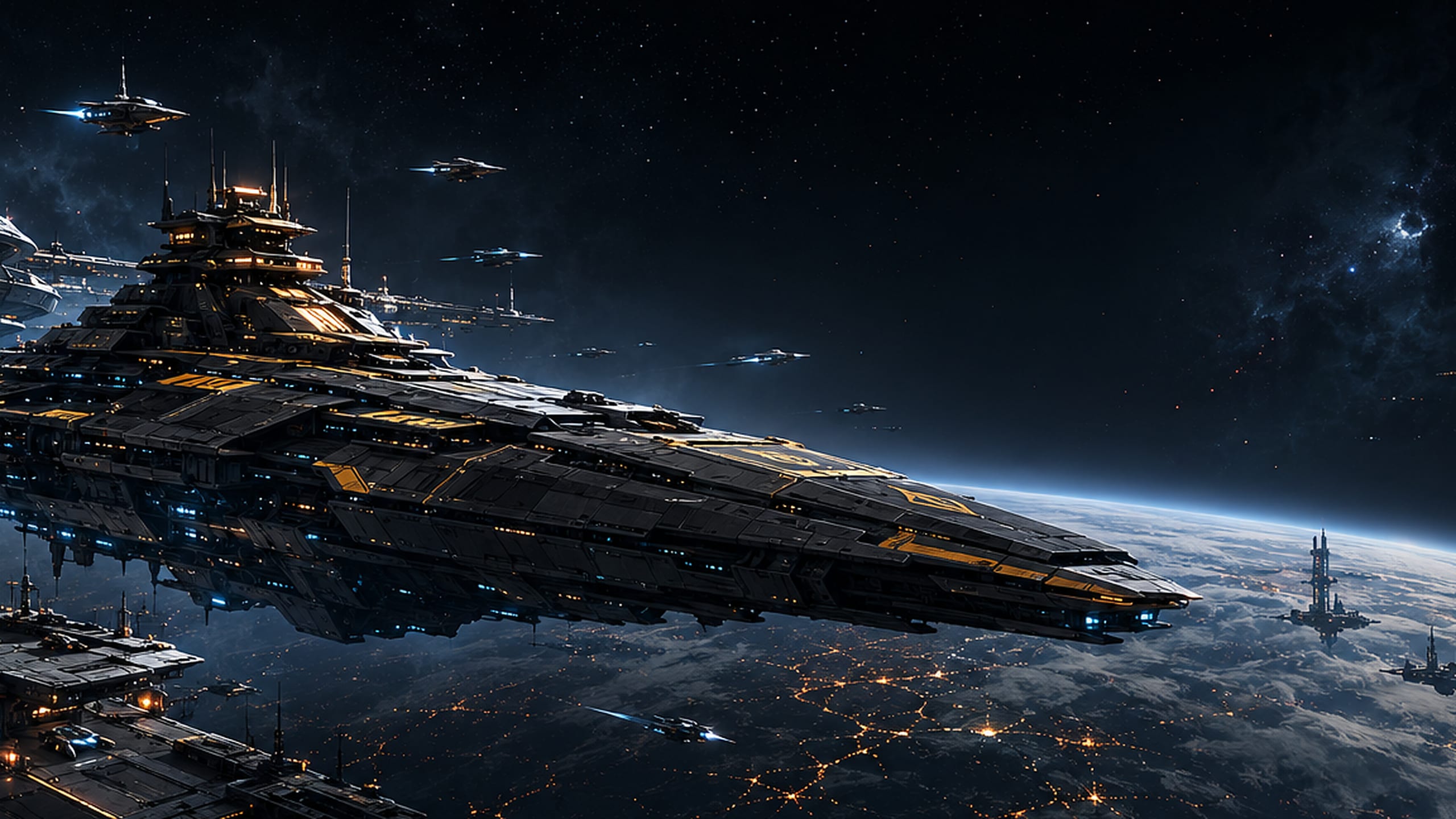
A dark armoured capital ship holding position above a planet at night, escorted by smaller craft.

Persistent faction space war

A war thatdoes not log out

VANTHELION is a top-down multiplayer space war fought across portal-linked sectors that keep running around the clock, played in an installed Windows client. Build one commander, master two switchable ship configurations, and take ground that is still yours tomorrow.

Platform
Windows 10 / 11
View
Top-down 3D
World
Always running
Build
In development
S01 / Doctrine

What kind of war this is

Three commitments that decide every other decision in the design. They are the reason the game is built this way and not another way.

Combat

You should always know why you won or lost

Click to move, lock a target, commit. Shield, hull, energy and heat stay readable at a glance, and every effect on screen has a purpose you can name. Ammunition, rockets and drones are real trade-offs rather than numbers that quietly go up. A fight you lose should teach you something specific — not leave you guessing which particle was the one that mattered.


Preparation

Half the battle happens in the hangar

Every hull carries two complete configurations, and you switch between them mid-fight. Preparation decides what you are capable of; execution decides whether it lands — target choice, positioning, switch timing, and knowing the exact moment to disengage. No item is strong enough to forgive a bad decision, and none is meant to be.

Persistence

The sectors do not wait for you

Space stays live while you are docked, asleep or at work. Quiet PvE frontiers harden into contested territory and wave gates. You mine, refine and craft, then move goods through a market other players actually set the prices in. Groups, clans and faction standing turn single fights into a long war — and a fifteen-minute session still moves something forward.

S02 / Allegiance

Three powers hold the lattice

Your faction sets your ships, your home space, your allies and your enemies. At launch it changes none of your base numbers — no faction is the correct one to pick, and none is the trap.

Hold the line

Aurelian Compact

Disciplined naval engineering: broad armoured wedges, layered ceramic over dark graphite, gold insignia that is earned rather than painted on. The Compact takes ground slowly and gives it up more slowly still.

  • Ceramic over graphite
  • Ceremonial geometry
  • Coordinated defence

Keep moving

Vesper Freeholds

Frontier shipwrights flying narrow, fast hulls built from replaceable modules and marked up in amber wherever a field repair went in. Freeholders hold that space belongs to whoever keeps their engines running and their word.

  • Modular frames
  • Exposed utility
  • Salvage and trade

Chart the unknown

Orison Directorate

Analysts of the anomalous: clean geometric shells, ring sensor arrays and sparse violet signal light. The Directorate surveys what the other powers route around, and arms itself with whatever it finds out there.

  • Split-plane armour
  • Ring sensors
  • Anomaly research
S03 / Operations

How a run actually goes

One loop, six steps, repeated at whatever length your evening allows.

01

Refit

Set both configurations in the hangar: weapons, shields, engine, ammunition, rockets, drones and consumables.

02

Launch

Undock into a live sector where other commanders, patrols and hostiles are already moving — nothing spins up because you arrived.

03

Engage

Move by clicking, lock a target and fight. Switch configuration when the engagement changes shape, or break off before it does.

04

Recover

Collect cargo, mine an asteroid field, take a contract objective, or salvage what the last fight left behind.

05

Transit

Cross a portal into deeper, more dangerous space — or back toward safety with a hold you would rather not lose.

06

Settle

Dock, refine, craft, list goods on the auction, bank faction standing and clan contribution, then plan the next run.

Around that loop sit the systems that make a sector feel inhabited: groups for the fights you cannot take alone, clans and faction standing that carry results between sessions, an auction where other players set the price, and wave gates that need a coordinated team rather than a bigger number.

Session lengths the game is designed around. A short evening should never be a wasted one.
Time at the deskDesigned to produce
5 – 10 minClaim tasks, refit, run a home-sector contract, check the auction.
15 – 25 minAn NPC route, a resource run, a daily contract or a small PvP patrol.
30 – 60 minA group gate, a convoy escort or a clan operation.
60 – 120 minA scheduled faction war, a progression push, coordinated farming.
S04 / The client

An installed client, not a browser tab

A native Windows application with an auto-updating installer. It is built to run well on an ordinary gaming PC, not only a new one.

Platform
Windows 10 and 11, 64-bit
Display
1280 × 720 minimum, 1920 × 1080 reference, ultrawide-aware
Input
Keyboard and mouse, fully remappable
Window
Borderless fullscreen by default, F11 toggles windowed
Runtime
Checks for the Microsoft WebView2 runtime and installs it when it is missing
Updates
Signed releases with published SHA-256 checksums, applied without a manual reinstall
Sign-in
Approved in your own browser and handed back to the client. The game never sees your password
Accessibility
Scalable interface, reduced motion, colour-independent friend and foe cues, a photosensitivity-safe effects mode
Hardware
Exact CPU, GPU and memory figures publish with the first public build
S05 / Status

Where the build stands

This panel is the download page. It stays honest about the fact that there is nothing to download yet.

Windows client

In development
Public build
None published. There is no installer to download today.
Internal build
A desktop client already connects to a live, always-on authoritative server and flies in a real sector. It is not ready for players, so it is not published.
What lands here
The exact version, build date, SHA-256 checksum and signed installer — verified, or it does not ship.
Server status
A public status page opens with the first playable build, alongside patch notes for every release.

Fairness is a design decision, not a promise

There is no monetization in VANTHELION today, and none ships until retention, fairness and economy stability have been measured on live data. Whatever arrives later is already bound by one rule: paying never substitutes for fighting. No purchased dominance, no hidden odds, no pressure to erase a death.

Development runs in the order the game deserves — server authority first, then the client in your hands. When there is something to install, it appears above with its checksum. What support will cover is written down already.